Tag: Content Strategy

  • Writing Better Studio Content: How Boutique Fitness Brands Can Communicate More Clearly

    Writing Better Studio Content: How Boutique Fitness Brands Can Communicate More Clearly

    Better fitness content isn’t about saying more. It’s about helping the right person understand your studio, trust your brand and know what to do next.

    Boutique fitness brands have more places to communicate than ever: websites, email, social media, mobile apps, booking platforms, push notifications and search.

    Yet one of the most common problems we see is surprisingly simple:

    Studios know exactly what makes their experience special, but their digital content doesn’t always communicate it.

    The result can be beautiful branding paired with vague messaging, confusing class descriptions or important information buried where prospective members can’t find it.

    Better content starts with clarity.

    Write for Someone Who Has Never Visited Your Studio

    Studio owners and instructors live inside their brands every day.

    Your prospective member doesn’t.

    Terms, class formats and policies that seem obvious internally may be completely unfamiliar to someone considering their first class.

    Before publishing content, ask:

    • Would a first-time visitor understand this?
    • Does it explain what the experience actually is?
    • Does it answer the questions someone might have before booking?
    • Is the next step obvious?

    Don’t assume familiarity.

    A statement like “50 minutes. Full body. No excuses.” might sound great, but it doesn’t tell a new visitor what they’re signing up for.

    Pair brand language with useful information:

    50 minutes. Full body. No excuses.
    Our instructor-led strength classes combine resistance training and conditioning in a high-energy, small-group environment.

    You can have personality and clarity at the same time.

    Answer the Questions Members Actually Ask

    Some of your best content ideas are already sitting in your inbox.

    Think about what prospective and current members repeatedly ask:

    • What should I expect during my first class?
    • Is this suitable for beginners?
    • What should I wear?
    • Do I need grip socks?
    • How early should I arrive?
    • Where should I park?
    • What’s the difference between your class types?
    • Which introductory offer should I choose?
    • Can I attend multiple locations?

    If your team answers the same question repeatedly, there’s a good chance the answer should exist somewhere in your digital experience.

    These questions can become FAQs, website sections, onboarding emails, social content and longer educational articles.

    Good content reduces uncertainty.

    Focus on Benefits, Not Just Features

    Studios naturally describe what they offer:

    “45-minute reformer class.”

    “12 reformers.”

    “Heated studio.”

    “On-demand library.”

    Those details matter, but members are ultimately trying to understand what those features mean for them.

    Connect the feature to the experience.

    Instead of:

    Access our on-demand library.

    Consider:

    Can’t make it into the studio? Train with your favorite instructors from home, while traveling or whenever your schedule changes.

    The feature hasn’t changed. The value is simply clearer.

    Give Every Page One Primary Job

    Trying to make every page communicate everything usually makes the experience harder to navigate.

    A homepage might primarily introduce the brand and move someone toward their first class.

    A class page should help someone understand the workout.

    A location page should help someone evaluate and visit that specific studio.

    A pricing page should make purchasing easier.

    A first-visit page should remove uncertainty.

    Before writing a page, decide:

    What should someone understand, and what should they do next?

    Then build the content around that objective.

    Make Your Calls to Action Specific

    “Learn More” isn’t always wrong, but it often wastes an opportunity to tell someone exactly what happens next.

    Consider calls to action such as:

    • View Schedule
    • Book Your First Class
    • Explore Memberships
    • Find Your Studio
    • Meet the Instructors
    • Start Your Free Trial
    • Watch On Demand

    The CTA should match the visitor’s stage in the journey.

    Someone learning about a class may not be ready to “Buy Now.” Someone already reviewing memberships probably doesn’t need another “Discover More.”

    Good content creates progression.

    Write for People First and Search Second

    Search optimization matters, but awkward keyword-heavy copy rarely creates a great member experience.

    Instead, clearly describe:

    • What you offer
    • Where you offer it
    • Who it’s for
    • How it works
    • What makes it different

    For example, a heading like “Reformer Pilates in Austin” communicates substantially more than “Move Differently.”

    You can still use “Move Differently” as brand language. Just give search engines, AI systems and prospective members enough context to understand what it means.

    This is becoming increasingly important as discovery expands beyond traditional search engines into AI-powered search experiences.

    Your Location Pages Should Actually Be Local

    For multi-location brands, copying the same paragraph across every location page and changing the city name misses an opportunity.

    Give each location useful information such as:

    • Neighborhood
    • Address and directions
    • Parking
    • Amenities
    • Class offerings
    • Instructors
    • Introductory offers
    • Local FAQs
    • Schedule

    Your location page should feel like the digital front door to that specific studio.

    Don’t Let AI Make Your Brand Generic

    AI can dramatically speed up content production, but it can also make every fitness studio sound the same.

    Phrases like “transform your journey,” “unlock your potential” and “become the best version of yourself” communicate very little when they could describe almost any fitness business.

    Use AI to help organize, edit, brainstorm and repurpose content.

    But give it real inputs:

    • Your actual methodology
    • Your audience
    • Your instructors
    • Your terminology
    • Your positioning
    • Your customer questions
    • Your brand voice

    AI works much better when it has something distinctive to work with.

    Repurpose What You Already Have

    You don’t need to start every piece of content from scratch.

    One strong piece of studio knowledge can become:

    Instructor expertise → Blog article → Newsletter → Social posts → FAQ → Website content

    A detailed explanation of your training method could become a class page, educational article and onboarding email.

    A frequently asked question could become a short video, social post and website FAQ.

    This creates consistency while reducing the amount of new material your team has to produce.

    Review Content Like a Member

    Before publishing, forget what you know about the business and read the page as a prospective customer.

    Can you quickly answer:

    What is this?

    Is it for me?

    Where is it?

    What does it cost?

    What should I expect?

    What do I do next?

    If the page can’t answer the questions that matter to its intended visitor, another paragraph of marketing copy probably isn’t the solution.

    Better structure and clearer information usually are.

    Better Content Creates a Better Member Experience

    Content isn’t separate from the customer experience.

    It’s part of it.

    Clear information can make someone more comfortable booking their first class. Better class descriptions can help members choose the right experience. Strong location pages can make studios easier to discover. Useful onboarding content can remove friction before someone ever walks through the door.

    The strongest boutique fitness content doesn’t try to sound impressive.

    It makes the experience easier to understand.

    Be specific. Be useful. Keep your brand personality. And always make the next step clear.
  • Building Member Retention Through Weekly Content Releases

    Building Member Retention Through Weekly Content Releases

    Your on-demand library shouldn’t just attract members at launch. It should give them a reason to keep coming back.

    Retention is one of the most important metrics in boutique fitness.

    Studios spend significant time and money acquiring members, but long-term growth depends on keeping those members engaged.

    On-demand fitness can support that goal, particularly when studios treat content as an ongoing experience rather than a one-time library.

    The Problem With the Static Video Library

    A studio launches on-demand with 30 or 50 workouts.

    Members explore it.

    Then nothing changes.

    Over time, even a strong library can start to feel stale.

    Streaming platforms have conditioned consumers to expect new content. Fitness doesn’t need to match the volume of major entertainment platforms, but the same principle applies:

    New content creates a reason to return.

    Consistency Beats Volume

    You don’t necessarily need to publish five workouts every week.

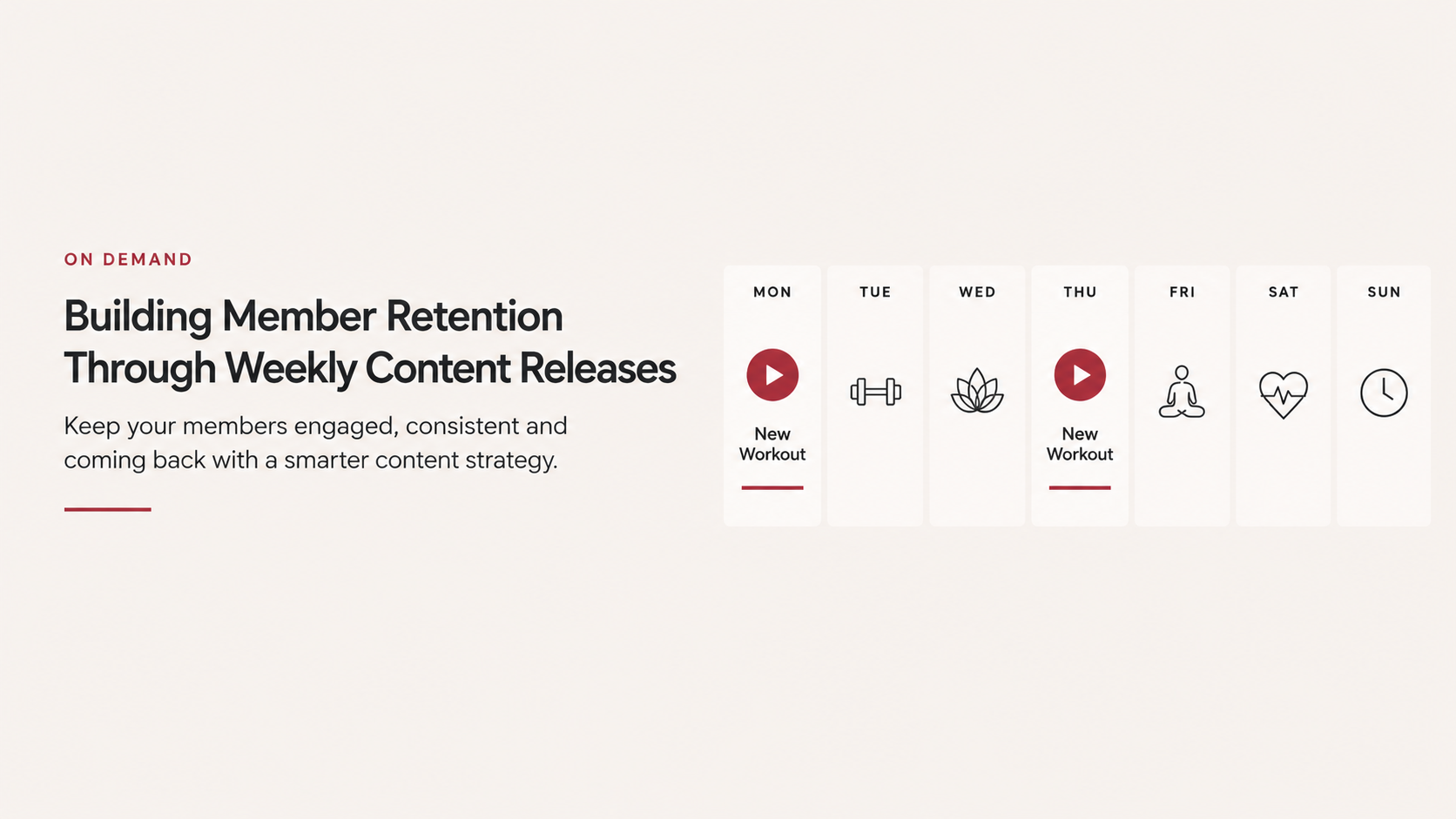
    One meaningful release each week can establish a predictable rhythm.

    For example:

    Monday: New workout
    Wednesday: Highlight the workout on social
    Friday: Feature it in member communications

    Now one piece of content generates multiple member touchpoints throughout the week.

    Over a year, one weekly release also creates more than 50 additional pieces of fitness content.

    That’s a substantial library without an unsustainable production schedule.

    Create Content Around Member Behavior

    Your releases shouldn’t be random.

    Think about when members need additional support.

    January might focus on consistency.

    Summer might feature travel-friendly workouts.

    The holidays might emphasize shorter classes.

    Recovery content could follow demanding studio challenges.

    Beginner series can support new-member acquisition periods.

    This turns on-demand from an archive into an extension of your programming strategy.

    Use Series to Build Habits

    Individual workouts are useful. Series can be even more powerful.

    Consider:

    • 7-Day Core Series
    • 4-Week Strength Program
    • Beginner Foundations
    • Mobility Week
    • Instructor Spotlight
    • 20-Minute Workout Series

    Series give members a reason to continue to the next piece of content.

    Instead of asking, “What should I take today?” the member already has a next step.

    That reduces decision fatigue while creating another opportunity for consistent engagement.

    Bring Your Instructors Beyond the Studio

    Instructor relationships are one of boutique fitness’s strongest retention advantages.

    Members develop connections with the people who coach them.

    On-demand allows those relationships to continue outside scheduled class times.

    A member traveling for work can still train with their favorite instructor. Someone who missed class can stay connected from home. A new member can become familiar with instructors before walking into their first session.

    Digital content shouldn’t replace that human connection.

    It can extend it.

    Connect Digital and In-Studio Experiences

    The most effective strategy isn’t necessarily “in-person versus digital.”

    It’s connected fitness.

    A studio challenge can include an on-demand recovery workout.

    An instructor can recommend a digital mobility session after class.

    A new member can receive a beginner collection after joining.

    A member traveling for two weeks can continue participating remotely.

    The physical studio remains the center of the community while digital content fills the gaps between visits.

    Give Members Something to Look Forward To

    Retention is ultimately about maintaining value over time.

    Weekly content releases communicate something important:

    There’s always something new happening here.

    That doesn’t require a massive production team or hundreds of videos. It requires a sustainable publishing rhythm and content that reflects what members actually need.

    With On Demand by IPSTUDIO™, boutique fitness studios can extend their member experience beyond the studio and build a digital content strategy designed for ongoing engagement.

    Don’t just build a library.

    Build a reason to come back.

  • How to Plan Your First Month of On-Demand Content

    How to Plan Your First Month of On-Demand Content

    You don’t need hundreds of videos to launch an effective on-demand fitness experience. You need the right content, organized around how your members actually train.

    Launching an on-demand library can feel overwhelming. How many classes do you need? How long should they be? Which instructors should you feature? How often should you publish something new?

    For most boutique fitness studios, the best approach is to start focused.

    Your first month should give members enough variety to find something they want to take while establishing a sustainable rhythm for your team.

    Start With Your Members, Not Your Camera

    Before recording anything, think about why your members would use on-demand content.

    A member might want to:

    • Take a full class when they can’t make it to the studio
    • Fit a 15-minute workout into a busy day
    • Continue training while traveling
    • Add mobility or recovery to their routine
    • Revisit a favorite instructor
    • Try a class type before taking it in person

    Those use cases should shape your initial library.

    The goal isn’t simply to recreate your studio schedule online. Digital content gives you the opportunity to serve moments that your physical schedule can’t.

    Build a Balanced Starter Library

    Instead of recording 20 versions of the same workout, create variety.

    For example, an initial library might include:

    Full-length classes
    Give members an experience similar to attending the studio.

    Express workouts
    Create 10–30 minute options for busy days.

    Beginner content
    Help newer members understand movements, equipment and class formats.

    Targeted workouts
    Think core, upper body, lower body, mobility or recovery.

    Instructor variety
    Feature different personalities and teaching styles from your studio.

    A smaller, thoughtfully organized library will usually be more useful than a large collection members struggle to navigate.

    Plan Your First Four Weeks

    You don’t need to publish everything on day one.

    Consider launching with a core collection and then adding content weekly.

    Week 1: Establish the experience
    Publish several foundational workouts representing your primary class types and instructors.

    Week 2: Add convenience
    Introduce shorter workouts and content designed for busy schedules.

    Week 3: Add variety
    Release targeted workouts, specialty formats or additional instructors.

    Week 4: Give members a reason to return
    Introduce a new series, challenge or featured workout.

    Now your on-demand experience feels active rather than static.

    Create a Repeatable Production Workflow

    Consistency matters more than perfection.

    Establish a simple workflow:

    Plan → Record → Edit → Upload → Categorize → Publish → Promote

    Batching content can make this dramatically easier. Instead of setting up equipment every week, record several workouts during one production session and release them gradually.

    Your content calendar can then stay active without requiring constant filming.

    Organize Content for Discovery

    Members shouldn’t have to scroll endlessly to find a workout.

    Useful collections might include:

    • 30 Minutes or Less
    • Beginner
    • Full Body
    • Strength
    • Mobility & Recovery
    • Instructor Collections
    • Most Recent

    Think of your library like a streaming service rather than a folder of videos.

    Good organization increases the likelihood that members actually use the content you’re creating. For equipment and delivery choices, use our practical live and on-demand setup guide.

    Promote Every Release

    Uploading a workout doesn’t mean members will discover it.

    Use your existing channels to introduce new content:

    • Email
    • Social media
    • Website
    • Studio signage
    • Instructor announcements
    • Mobile app

    A simple weekly “New this week” message can give members another reason to interact with your brand.

    Don’t Wait for a Perfect Library

    One of the easiest mistakes is delaying launch because you don’t have enough content.

    Start with a useful foundation. Learn what members watch. Then build around actual engagement.

    Your first month isn’t about creating the final version of your on-demand library.

    It’s about establishing the habit, for both your members and your team.

    With a clear content strategy and a connected platform like On Demand by IPSTUDIO™, your digital library can become an extension of the studio experience that keeps members connected wherever they are.

  • How to Use a Blog to Boost Your Fitness Studio’s SEO

    How to Use a Blog to Boost Your Fitness Studio’s SEO

    Your fitness studio website shouldn’t just look good, it should help new clients find you.

    One of the simplest and most affordable ways to improve your website’s visibility on Google is also one of the most overlooked: blogging.

    You don’t need to become a full-time content creator or publish something every week. A small library of useful, well-written articles can help your website show up for more searches, answer questions prospective clients are already asking, and build authority for your studio over time.

    Here’s how it works, and how to make blogging manageable.

    Why Blogging Helps Fitness Studio SEO

    Think about how someone searches for a fitness studio.

    They may search directly for:

    • Pilates studio in Austin
    • Reformer Pilates near me
    • Spin classes in Denver
    • Best yoga studio in Scottsdale

    But those aren’t the only searches happening.

    Potential clients are also asking questions like:

    • What should I expect at my first Pilates class?
    • Is reformer Pilates good for beginners?
    • What should I wear to hot yoga?
    • How often should I take Pilates?
    • What’s the difference between Lagree and Pilates?
    • How do I prepare for my first cycling class?

    These searches create opportunities.

    Your homepage and class pages can only cover so much. A blog gives your website additional pages that can answer these specific questions and appear in relevant search results.

    Over time, those articles also help search engines better understand what your studio offers, where you operate, and what topics your website is an authority on.

    Blogging Is More Affordable Than You Might Think

    SEO can sound like something that requires a large marketing budget, an agency, or complicated software.

    Blogging doesn’t.

    If your website already has a blog, the primary investment is creating useful content. You can start with the knowledge your team already has.

    Your instructors answer questions every day. Your front desk explains memberships, class formats, and what first-timers should expect. Your studio probably already creates educational content for Instagram, newsletters, or other marketing channels.

    Much of that knowledge can become searchable website content.

    And unlike a social post that may disappear from your audience’s feed within a few days, a useful blog article can continue attracting visitors through search for months—or even years.

    What Should a Fitness Studio Write About?

    Start with your customers, not with keywords.

    Ask yourself: What does someone want to know before they book their first class?

    Those questions are often some of your best blog topics.

    For a Pilates studio, that might include:

    • Reformer Pilates vs. mat Pilates
    • What to expect at your first reformer class
    • Pilates for beginners
    • How often should you do Pilates?
    • What to wear to Pilates
    • Benefits of Pilates
    • Private sessions vs. group classes

    A cycling studio could cover first-ride preparation, cycling shoes, class intensity, recovery, or different class formats.

    A yoga studio could create resources around beginner yoga, class styles, heated vs. non-heated classes, equipment, flexibility, or preparing for your first class.

    The goal isn’t to write about everything related to fitness. Write about the subjects most closely connected to what your studio actually does.

    Make Your Content Local

    For a fitness studio, local visibility matters.

    You generally don’t need thousands of website visitors from around the country. You need the right people in your market discovering your studio.

    That makes local content particularly valuable.

    Instead of only writing:

    “A Beginner’s Guide to Reformer Pilates”

    you might publish:

    “A Beginner’s Guide to Reformer Pilates in Austin”

    Where appropriate, naturally mention your neighborhood, city, instructors, studio, or local community within the article.

    Don’t force your location into every sentence. Write naturally for a real person first, while giving search engines enough context to understand where your business operates.

    Connect Your Blog to the Rest of Your Website

    A blog shouldn’t be an island.

    If you write an article explaining what someone should expect during their first Pilates class, link readers directly to your Pilates class page or schedule.

    If you write about membership options, link to your pricing page.

    If you mention a specific studio, link to its location page.

    These internal links make it easier for visitors to take the next step while also helping search engines understand the structure and important pages of your website.

    A simple path might look like:

    Google Search → Helpful Article → Class Information → Schedule → Book

    That’s where SEO becomes more than website traffic. It becomes part of your customer journey.

    You Don’t Need to Post Every Week

    Consistency is useful, but quality matters more than volume.

    For most boutique fitness studios, publishing one or two genuinely useful articles per month is a much better strategy than trying to publish several low-quality posts every week.

    Start with 10–20 questions your team hears regularly.

    Turn each into an article.

    You now have months of potential content without having to constantly brainstorm new ideas.

    Even publishing once per month gives you 12 new searchable pages every year.

    A Few Simple Tips for Better Results

    Answer one clear question per article.
    A focused article usually has a better chance of being useful than trying to cover an entire fitness category at once.

    Use descriptive titles.
    “5 Things to Know Before Your First Reformer Pilates Class” tells both readers and search engines exactly what the page is about.

    Use headings.
    Break longer articles into clear sections so visitors can quickly scan for the information they need.

    Write like your studio.
    SEO content doesn’t need to sound robotic. Your blog should still reflect your studio’s personality and expertise.

    Include your location naturally.
    Your city, neighborhood, and studio locations can provide important context for local searches.

    Link to relevant pages.
    Guide readers toward classes, instructors, pricing, locations, schedules, and other useful parts of your website.

    Keep old articles updated.
    If pricing, policies, class formats, or recommendations change, update the article rather than letting outdated information remain online.

    Prioritize helpfulness over keyword stuffing.
    You don’t need to repeat “Pilates studio Austin” 15 times. Write the best answer to the question and make the topic and location clear.

    Turn Content You’re Already Creating Into Blog Posts

    You may already have more blog content than you realize.

    A strong Instagram caption can become the foundation of an article. A frequently asked question can become a 700-word guide. An instructor Q&A can become an educational post. A newsletter explaining a new class format can become an evergreen website resource.

    One idea can also work across multiple channels:

    Blog article → Email newsletter → Instagram post → Stories → Google Business Profile update

    Instead of constantly creating more content, get more mileage out of the content you’re already producing.

    Does Blogging Actually Work for Fitness Studios?

    Blogging isn’t an overnight SEO trick.

    A new article may take time to be discovered and gain visibility in search. But every useful article adds another relevant page to your website and another potential way for someone to discover your business. For the newer discovery context, see our guide to AI-assisted studio discovery.

    Publish 20 useful articles answering questions about your services, classes, instructors, and local market, and your website now has 20 additional opportunities to meet potential clients while they’re searching.

    That effect can compound over time.

    And because the content lives on a website you control, you’re building an asset for your studio rather than relying entirely on paid advertising or social media algorithms.

    Start Simple

    You don’t need an elaborate content strategy to get started.

    Pick five questions your studio gets all the time.

    Choose one.

    Write the clearest, most useful answer you can.

    Add a few headings, link to the relevant pages on your website, include a clear next step, and publish it.

    Then do it again next month.

    SEO is rarely about finding one magic tactic. It’s about consistently making your website more useful, relevant, and discoverable.

    For fitness studios, a simple blog is one of the easiest ways to start doing exactly that.

    Build a Website That Can Grow With Your Studio

    Your website should do more than provide basic information. It should help people discover your studio, understand what makes it different, and move easily from search to booking.

    IPSTUDIO Fitness Websites™ are built specifically for boutique fitness studios, with integrated booking experiences, mobile-first design, managed hosting, ongoing support, and a website foundation your studio can continue building on as you grow.