Tag: boutique fitness

  • How to Use a Blog to Boost Your Fitness Studio’s SEO

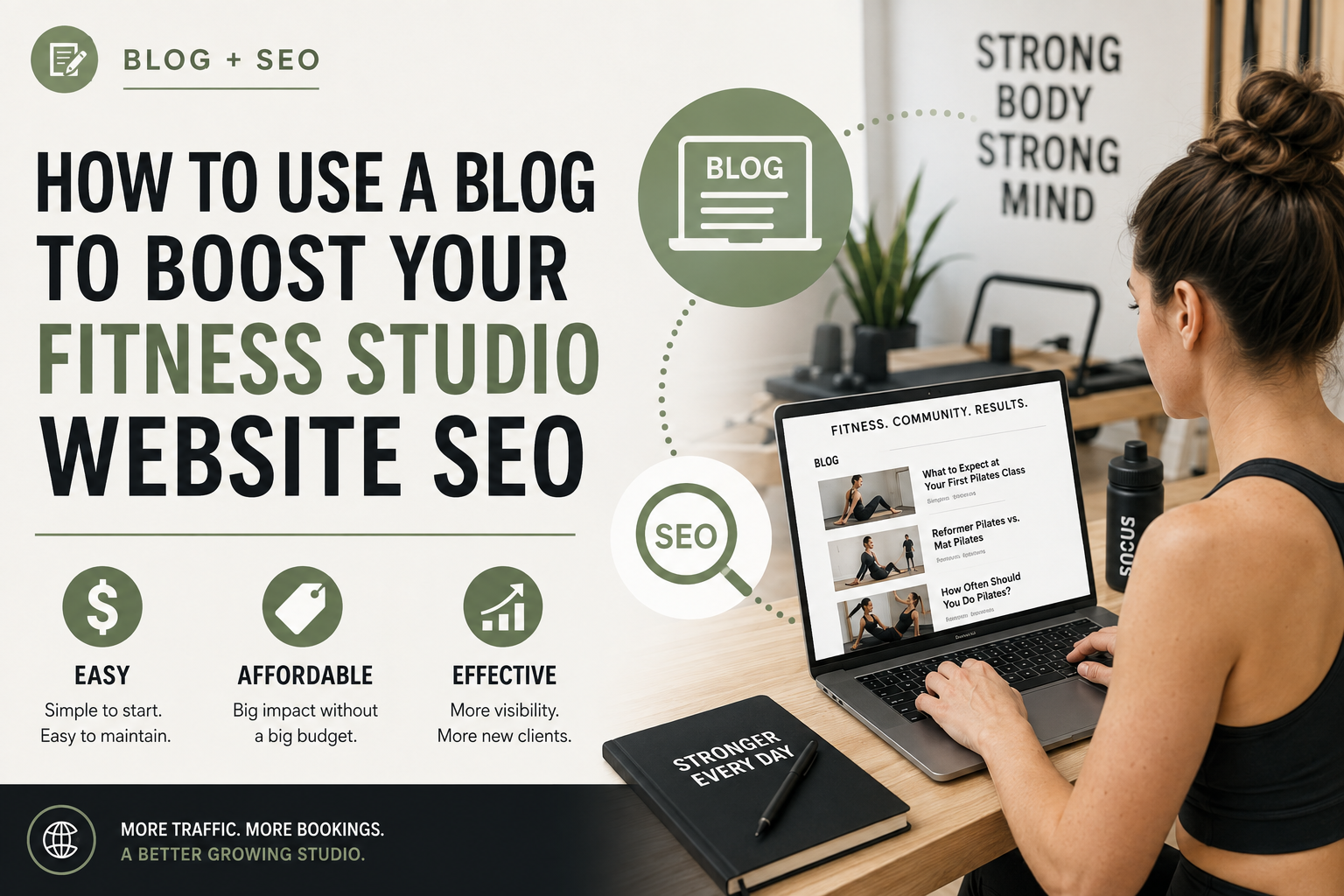
    How to Use a Blog to Boost Your Fitness Studio’s SEO

    Your fitness studio website shouldn’t just look good, it should help new clients find you.

    One of the simplest and most affordable ways to improve your website’s visibility on Google is also one of the most overlooked: blogging.

    You don’t need to become a full-time content creator or publish something every week. A small library of useful, well-written articles can help your website show up for more searches, answer questions prospective clients are already asking, and build authority for your studio over time.

    Here’s how it works, and how to make blogging manageable.

    Why Blogging Helps Fitness Studio SEO

    Think about how someone searches for a fitness studio.

    They may search directly for:

    • Pilates studio in Austin
    • Reformer Pilates near me
    • Spin classes in Denver
    • Best yoga studio in Scottsdale

    But those aren’t the only searches happening.

    Potential clients are also asking questions like:

    • What should I expect at my first Pilates class?
    • Is reformer Pilates good for beginners?
    • What should I wear to hot yoga?
    • How often should I take Pilates?
    • What’s the difference between Lagree and Pilates?
    • How do I prepare for my first cycling class?

    These searches create opportunities.

    Your homepage and class pages can only cover so much. A blog gives your website additional pages that can answer these specific questions and appear in relevant search results.

    Over time, those articles also help search engines better understand what your studio offers, where you operate, and what topics your website is an authority on.

    Blogging Is More Affordable Than You Might Think

    SEO can sound like something that requires a large marketing budget, an agency, or complicated software.

    Blogging doesn’t.

    If your website already has a blog, the primary investment is creating useful content. You can start with the knowledge your team already has.

    Your instructors answer questions every day. Your front desk explains memberships, class formats, and what first-timers should expect. Your studio probably already creates educational content for Instagram, newsletters, or other marketing channels.

    Much of that knowledge can become searchable website content.

    And unlike a social post that may disappear from your audience’s feed within a few days, a useful blog article can continue attracting visitors through search for months—or even years.

    What Should a Fitness Studio Write About?

    Start with your customers, not with keywords.

    Ask yourself: What does someone want to know before they book their first class?

    Those questions are often some of your best blog topics.

    For a Pilates studio, that might include:

    • Reformer Pilates vs. mat Pilates
    • What to expect at your first reformer class
    • Pilates for beginners
    • How often should you do Pilates?
    • What to wear to Pilates
    • Benefits of Pilates
    • Private sessions vs. group classes

    A cycling studio could cover first-ride preparation, cycling shoes, class intensity, recovery, or different class formats.

    A yoga studio could create resources around beginner yoga, class styles, heated vs. non-heated classes, equipment, flexibility, or preparing for your first class.

    The goal isn’t to write about everything related to fitness. Write about the subjects most closely connected to what your studio actually does.

    Make Your Content Local

    For a fitness studio, local visibility matters.

    You generally don’t need thousands of website visitors from around the country. You need the right people in your market discovering your studio.

    That makes local content particularly valuable.

    Instead of only writing:

    “A Beginner’s Guide to Reformer Pilates”

    you might publish:

    “A Beginner’s Guide to Reformer Pilates in Austin”

    Where appropriate, naturally mention your neighborhood, city, instructors, studio, or local community within the article.

    Don’t force your location into every sentence. Write naturally for a real person first, while giving search engines enough context to understand where your business operates.

    Connect Your Blog to the Rest of Your Website

    A blog shouldn’t be an island.

    If you write an article explaining what someone should expect during their first Pilates class, link readers directly to your Pilates class page or schedule.

    If you write about membership options, link to your pricing page.

    If you mention a specific studio, link to its location page.

    These internal links make it easier for visitors to take the next step while also helping search engines understand the structure and important pages of your website.

    A simple path might look like:

    Google Search → Helpful Article → Class Information → Schedule → Book

    That’s where SEO becomes more than website traffic. It becomes part of your customer journey.

    You Don’t Need to Post Every Week

    Consistency is useful, but quality matters more than volume.

    For most boutique fitness studios, publishing one or two genuinely useful articles per month is a much better strategy than trying to publish several low-quality posts every week.

    Start with 10–20 questions your team hears regularly.

    Turn each into an article.

    You now have months of potential content without having to constantly brainstorm new ideas.

    Even publishing once per month gives you 12 new searchable pages every year.

    A Few Simple Tips for Better Results

    Answer one clear question per article.
    A focused article usually has a better chance of being useful than trying to cover an entire fitness category at once.

    Use descriptive titles.
    “5 Things to Know Before Your First Reformer Pilates Class” tells both readers and search engines exactly what the page is about.

    Use headings.
    Break longer articles into clear sections so visitors can quickly scan for the information they need.

    Write like your studio.
    SEO content doesn’t need to sound robotic. Your blog should still reflect your studio’s personality and expertise.

    Include your location naturally.
    Your city, neighborhood, and studio locations can provide important context for local searches.

    Link to relevant pages.
    Guide readers toward classes, instructors, pricing, locations, schedules, and other useful parts of your website.

    Keep old articles updated.
    If pricing, policies, class formats, or recommendations change, update the article rather than letting outdated information remain online.

    Prioritize helpfulness over keyword stuffing.
    You don’t need to repeat “Pilates studio Austin” 15 times. Write the best answer to the question and make the topic and location clear.

    Turn Content You’re Already Creating Into Blog Posts

    You may already have more blog content than you realize.

    A strong Instagram caption can become the foundation of an article. A frequently asked question can become a 700-word guide. An instructor Q&A can become an educational post. A newsletter explaining a new class format can become an evergreen website resource.

    One idea can also work across multiple channels:

    Blog article → Email newsletter → Instagram post → Stories → Google Business Profile update

    Instead of constantly creating more content, get more mileage out of the content you’re already producing.

    Does Blogging Actually Work for Fitness Studios?

    Blogging isn’t an overnight SEO trick.

    A new article may take time to be discovered and gain visibility in search. But every useful article adds another relevant page to your website and another potential way for someone to discover your business. For the newer discovery context, see our guide to AI-assisted studio discovery.

    Publish 20 useful articles answering questions about your services, classes, instructors, and local market, and your website now has 20 additional opportunities to meet potential clients while they’re searching.

    That effect can compound over time.

    And because the content lives on a website you control, you’re building an asset for your studio rather than relying entirely on paid advertising or social media algorithms.

    Start Simple

    You don’t need an elaborate content strategy to get started.

    Pick five questions your studio gets all the time.

    Choose one.

    Write the clearest, most useful answer you can.

    Add a few headings, link to the relevant pages on your website, include a clear next step, and publish it.

    Then do it again next month.

    SEO is rarely about finding one magic tactic. It’s about consistently making your website more useful, relevant, and discoverable.

    For fitness studios, a simple blog is one of the easiest ways to start doing exactly that.

    Build a Website That Can Grow With Your Studio

    Your website should do more than provide basic information. It should help people discover your studio, understand what makes it different, and move easily from search to booking.

    IPSTUDIO Fitness Websites™ are built specifically for boutique fitness studios, with integrated booking experiences, mobile-first design, managed hosting, ongoing support, and a website foundation your studio can continue building on as you grow.

  • The State of Live & On-Demand Video For Boutique Fitness

    The State of Live & On-Demand Video For Boutique Fitness

    Published March 23, 2020

    The demand for wellness and fitness products/services has grown ten-fold in the last decade. with the advent of new exercise modalities, a societal desire to experience the process of self-improvement with friends & family, and the existence of software that can streamline the experience —  boutique fitness has consistently shown that it’s in a renaissance period.

    Where Are We Now?

    With the arrival of the coronavirus (covid-19), the fitness industry has been forced to adapt, while the anxiety of changing times looms. once again, clients are resorting to home-based, individualized workouts to get their daily burn in. All of a sudden, it feels like years of progress towards the establishment of the brick & mortar boutique fitness industry is in jeopardy. With headline after headline highlighting that the future of fitness has changed  — business owners have been forced to think outside the box on how they’ll continue to serve clients in a new world.

    Luckily for owners, fitness has had a cohesive relationship with the digital world in recent times. with the most expensive real estate in the world now existing in the palm of our hands, and a client-base that already spends a significant amount of time there — it’s clear that success lies in becoming a tech-enabled business. and management teams have done just that, with heavy investments in the production and distribution of video content via a branded website/social media to capitalize on clients’ sustained desire for fitness consumption. 

    At IPSTUDIO, we’ve witnessed the use of a multitude of platforms to do so, and the results have been encouraging to say the least. studios have been able to successfully reconnect with their clients via live streams or on-demand libraries through platforms such as: zoom, instagram, facebook, zype, and vimeo. It’s been really amazing to see the level of client engagement studios have been able to maintain through such mediums, and to see a clear path for their future.

    However, these mediums of distribution have not come without their downsides. the digital real estate and share-ability these platforms provide, comes with the challenge of monetization. live streams via social media simply can’t be monetized, and streams hosted via zoom require instillation and can be shared freely amongst those looking for a free viewing. on top of this, none of these solutions offer a native integration with a cms, booking platform, or business management software built for boutique fitness.

    The Way Forward

    To solve this problem, we created Live by IPSTUDIO™ & On Demand by IPSTUDIO™.

    Live & on-demand video solutions built specifically for boutique fitness. these products exist as end-to-end integrations that allow clients to buy, book, and view content/streams all without having to leave a studio’s website.

    With the primary benefit of this being that all attendees will need to login using their credentials with the studio’s booking platform, and will need to have purchased access to the content/stream to participate. studios will now have the flexibility to share links to live streams & on-demand content freely, without having to worry if viewers are paying customers or not. On the on-demand front, users will get to browse, view, and favorite content in a modern video library. studios can now return to offering credits & memberships for services through their website, and once again can track activity & purchases through their booking platform’s reporting module. Digital content will also remain compatible with classpass, and other class-based distribution networks.  For a later platform release, see the V4 On Demand announcement.

    We quietly rolled out the first versions of these integration products over the past week, and the amount of positive feedback we’ve received so far has been substantial. turnaround time with the setup process has also been kept low, and since our soft release last week we’ve already launched a double digit number of studios. For the later Zoom-specific integration, see the Live by IPSTUDIO x Zoom launch.

    If you are a studio owner (or affiliated with a studio leadership team) looking to integrate digital video into a booking software, we encourage you to reach out to ipstudio at hello@ipstudio.co for help. we’re taking a long-term approach to these services.

    Based on all indications, most studio’s we’ve worked with view the emergence of digital offerings not only as a long-term solution, but as a viable stream of revenue for the years to come. For current planning context, see our on-demand strategy for boutique studios.

  • Top 3 CRMs in Boutique Fitness 

    Top 3 CRMs in Boutique Fitness 

    Fitness has evolved over the decades. It is no longer about big box brands and racking up the weights. As boutique fitness continues to evolve wellness brands are turning towards boutique fitness focused software services to streamline and simplify both in studio and online experiences.

    We’ve made this short list based on the number of fitness brands being serviced and the product offerings.  

    MindBody

    This wellness service company has witnessed exponential growth across the world servicing over 130 countries and over 50,000 wellness, fitness businesses globally. As a boutique fitness software titan, MindBody earns a spot on every fitness software list.

    PROS

    • Intuitive UI for customers
      • The Mindbody fitness app for customers is relatively intuitive and easy to use. Fitness enthusiasts can peruse the options in nearby areas for different classes offered by fitness boutiques and book them online.
    • Dedicated suite for Marketing
      • Marketing is the backbone of future and flourishing businesses. You have to stay ahead of the curve to beat the competition. Mindbody offers a range of marketing tools to increase reach and acquire customers through various media channels. 

    CONS

    • Unreliable software updates
      • Business owners often complain about the updates to the app, that break payment gateways and more. It results in loss of business, lower customer retention and more.
    • Slow customer support
      • Todays customers need answers, fast. With MindBody having tens of thousands of customers to manage their customer support is often lackluster.

    Mariana Tek

    Built by boutique fitness industry veterans, Mariana Tek ticks all the right boxes when it comes to fitness boutique CRMs. From their best-in-class mobile app, to streamlined booking flow, Mariana Tek is in a league of their own. This company packs a major punch and offers top notch service and support.

    PROS

    • Maximize Revenue Generation
      • From a seamless booking flow to their award winning mobile app, Mariana Tek’s platform is sure to increase conversions and boost revenue. Veering revenue upwards is one the primary goal of any business and Mariana Tek facilitates that with their software.
    • Seamless Mobile App
      • Beautifully designed, seamlessly built the Mariana Tek iOS and Android experiences are by far the best in the boutique fitness industry. Packed with a customizable area where your own integrations can fit, to advanced notification alerts, the Mariana Tek app is second to none.
    • Easy to Switch
      • It is not too late if you are discovering Mariana Tek. Migrate to Mariana Tek easily with the assistance of onboard dedicated migration specialist and easy to use tools. Hit the road with little down-time for your business with dedicated customer support.  For the website side of a Mariana Tek transition, see our integration-launch overview.
    • API + Support
      • Having experienced API development across the boutique fitness landscape, there is no better platform than Mariana Tek to work with. From their dedicated integrations team to technical support and developer documentation, everything is on point.

    Cons

    • Slightly more expensive than competition
      • You get what you pay for, right?

    Zingfit

    An industry vet and global service provider, Zingfit’s boutique software product lays particular emphasis on the backend aspects of running a successful fitness boutique. 

    PROS

    • Spot Scheduling
      • Online spot scheduling allows customers to book a particular space in class, equipment like one specific treadmill, mat, bench amongst other things from their app in advance. They don’t need to wait or arrive early to secure a spot.  
    • Instructor Management
      • Build your instructor’s schedule with Zingfit’s tools and manage instructor schedules with ease. Identify your star instructors by enabling ratings for them, whom the customers enjoy the most. Your best instructors are the face of the business. They help increase footfall in the long-run through positive word of mouth alone. 
    • Multi-Studio
      • Zingfit’s multi-studio configuration enables customers to manage several fitness studios from one administrator panel. Business owners would not need to shuffle between multiple dashboards for different studios. 

    CONS

    • No API available
      • No custom API development resources or integrations are currently available. Achieving customized experiences isn’t possible with Zingfit. 

    Bottom Line

    To sum it up, choosing the right boutique fitness software for your business requires a clear assessment of your needs, objectives and budget. If it were up to us, we’d choose Mariana Tek every time.

  • Free & Affordable Tools for Studios New to Live & On-Demand Content Creation

    Free & Affordable Tools for Studios New to Live & On-Demand Content Creation

    Live streaming and on-demand libraries aren’t a pandemic pivot anymore.

    They’re a retention strategy.

    Today’s members expect flexibility:

    • Traveling but still want their workouts
    • Missed class and want to catch up
    • Prefer hybrid (in-studio + at home)
    • Want bonus content beyond the weekly schedule

    If done correctly, Live + On-Demand becomes:

    • A retention engine
    • A lead generator
    • A premium upsell opportunity
    • A multi-location value booster

    If done poorly, it becomes:

    • Random uploads
    • Clunky external platforms
    • Low engagement
    • High churn

    This guide walks through how to do it right — without overcomplicating it.

    Step 1: Get Clear on the Goal

    Before buying equipment, ask:

    • Are we retaining members?
    • Are we launching a digital-only tier?
    • Are we supporting multi-location access?
    • Are we increasing app engagement?
    • Are we creating premium programs?

    Gear doesn’t drive revenue.

    Strategy does.

    Affordable Equipment That Actually Works

    You do not need to build a movie studio.

    You need reliable tools that deliver clean audio and stable video.

    Webcams (Fast, Reliable, No Complexity)

    If you’re streaming from a laptop, a high-quality webcam is often enough.

    Popular options include:

    • Logitech Brio
    • Logitech StreamCam

    Why studios like them:

    • Plug and play
    • Crisp HD
    • No capture card required
    • Affordable

    For many studios, this is the smartest starting point.

    Dedicated Cameras (Better for On-Demand Libraries)

    If you’re building a structured on-demand library, you may want more control.

    Two strong options:

    • Zoom Q2n-4K Handy Video Recorder
      Budget-friendly, built-in mic, reliable.
    • Sony ZV-E10
      Higher image quality and excellent autofocus for instructors who move around.

    If using HDMI output, you’ll need a simple capture card (HDMI → USB).

    Beginner-Friendly Streaming Cameras

    The Mevo Start is popular for studios that want:

    • App control
    • Auto-tracking
    • Clean livestream setup without heavy tech

    If you want “set it and teach,” this is worth exploring.

    Audio: The Most Overlooked Upgrade

    Poor audio destroys perceived quality — instantly.

    Good audio builds professionalism.

    Options include:

    • Wireless headset mic (best for instruction clarity)
    • Rode Wireless GO II
    • Lavalier mic under shirt

    If you invest in only one upgrade, make it audio.

    Lighting (Don’t Skip This)

    You don’t need a Hollywood setup.

    You need:

    • 1–2 LED panels
    • Light facing the instructor (not behind)
    • Even front lighting

    Even a modest lighting investment dramatically improves quality.

    Budget Option: Use an iPhone

    For export settings, see our 1080p export and file-size guidance. Modern iPhones shoot up to 4K — but for studio content:

    • Shoot 1080p
    • 30fps
    • Good lighting
    • External mic if possible

    For many studios, this is more than sufficient.

    Software: Keep It Simple

    Editing

    • iMovie (Mac)
    • CapCut
    • Adobe Premiere Pro

    Most studios only need:

    • Trim
    • Add intro/outro
    • Adjust audio
    • Export

    Overproducing delays consistency.

    Live Streaming

    • Streamlabs
    • Zoom
    • Native in-app livestream tools (if supported by your booking system)

    Simple, stable, repeatable systems outperform flashy setups that break mid-class. For an automated workflow, explore Zoom livestream automation.

    Monetization: Where Studios Win or Lose

    Here’s the real question:

    How are members accessing this content?

    Strong models we’re seeing in 2026:

    • Included in unlimited membership
    • $29–$59/month digital-only tier
    • Premium “Hybrid+” membership
    • Program-based bundles
    • Challenge-specific content
    • Multi-location access enhancement

    The key is integration.

    If members leave your ecosystem to access video, engagement drops.

    If it lives inside your app or website experience, retention increases.

    What Actually Moves Revenue

    Let’s be direct:

    1. Consistency beats perfection
    2. Clear audio beats 4K resolution
    3. Weekly structured drops beat random uploads
    4. In-app integration beats external hosting
    5. Strategy beats equipment

    Studios that win with On-Demand treat it like programming — not a side project. For a concrete starting plan, see our guide to your first month of on-demand content.

    Think:

    • 6-week reformer progression
    • Beginner foundations series
    • Mobility track
    • Travel workouts
    • Instructor-exclusive content
    • Seasonal challenges

    That’s how LTV increases.

    How IPSTUDIO Supports Studios

    At IPSTUDIO, we don’t just help studios upload videos.

    We help you:

    • Integrate Live + On-Demand directly into your member ecosystem
    • Align with your booking system
    • Optimize UX across web + app
    • Create structured monetization pathways
    • Launch cleanly and professionally

    If you’re ready to turn Live + On-Demand into a real revenue channel — not just a content library — let’s talk.

    hello@ipstudio.co